Deciding between Google Ads vs Bing Ads is often the difference between a high-growth year and a wasted marketing budget. While Google is the household name, Microsoft Advertising (formerly Bing Ads) has become a high-performance alternative for brands looking for better ROI. In 2025, the debate isn’t about which is “better”—it’s about how to use both to dominate your niche.
1. Reach and Market Share: Volume vs. Precision
The biggest differentiator is the size of the audience.
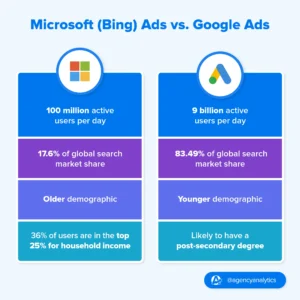
- Google Ads: The undisputed king. Google holds roughly 90% of the global search market, processing over 8.5 billion searches daily. It includes Google Search, YouTube, Gmail, and the Google Display Network. If you need massive volume, Google is your first stop.
- Microsoft (Bing) Ads: While its global share is smaller (around 8–12%), Bing is a powerhouse in the U.S. desktop market, where it captures nearly 30% of searches. Your ads also appear on Yahoo, AOL, DuckDuckGo, and even the Netflix ad-supported tier.
2. Cost and Competition: The Budget Factor
If you are working with a tighter budget or in a highly competitive industry (like Legal or Insurance), Bing often provides more “bang for your buck.”
- Average CPC: Microsoft Advertising CPCs are typically 30–50% lower than Google Ads.
- Competition: Because most brands flock to Google first, the auction environment on Bing is less crowded. This often leads to higher ad positions for a fraction of the price.
3. Audience Demographics: Who Are You Targeting?
The “who” is just as important as the “how many.”
- Google’s Audience: Diverse, mobile-heavy, and spans every age group. It is the go-to for e-commerce, apps, and local “near me” searches.
- Bing’s Audience: Generally older (35+), more affluent, and more educated. Because Bing is the default on Windows office computers, its users are often desktop-based professionals. This makes it a goldmine for B2B brands and high-ticket services.
4. Unique Targeting Features
Both platforms offer standard geographic and demographic targeting, but they have unique “secret weapons”:
- Google’s Strength: Advanced AI-powered bidding and “Performance Max” campaigns that use Google’s massive data ecosystem to find customers across every channel automatically.
- Bing’s Strength: LinkedIn Profile Targeting. Because Microsoft owns LinkedIn, you can target users by their specific company, job function, or industry. For a B2B marketer, this level of precision is unmatched by Google.
Comparison at a Glance (2025 Data)
| Feature | Google Ads | Microsoft (Bing) Ads |
| Market Share | ~90% (Global) | ~10% (Global) / ~30% (US Desktop) |
| Avg. Cost-Per-Click | Higher ($2.00 – $5.00+) | Lower ($1.00 – $2.00) |
| Primary Device | Mobile & Desktop | Desktop (Workplace focus) |
| Best For | Massive scale, B2C, Apps | B2B, Older/Wealthy demographics |
| Special Feature | YouTube & Local Search | LinkedIn Profile Targeting |
Which Should You Choose?
Choose Google Ads if:
* You need to scale quickly and reach the widest possible audience.
* Your product is visual (YouTube/Display) or mobile-first.
* You have the budget to compete in a high-stakes auction.
Choose Microsoft Ads if:
* You are in the B2B space and want to target decision-makers.
* You want a lower Cost-Per-Acquisition (CPA) and higher ROI.
* You want to “own” the desktop space while your competitors fight over mobile.
The Pro Strategy: Use Both
Most successful brands start with Google to capture volume and then import their campaigns directly into Microsoft Advertising. This allows you to capture the “other 10%” of the market—often the most affluent 10%—without extra setup time.